Transparency, authenticity and credibility are the three mantras to the success of any media platform, and this is true even in the case of social media, to make business sense. This is even more important as company representatives, knowingly or unknowingly, are now engaging themselves in social media communication. In these circumstances, the thin line between what is ethical and unethical for the consumer, and also from the business perspective, becomes very difficult to demarcate.
Today, social media is an outlet not just for sharing information with the world, either from customer to customer, or from consumer to business or the other way round, but is also an important platform for product and theme promotions.
When there are commercial interests involved, it becomes imperative that the platform is regulated. Restrictions here would mean a centralized body that legislates, and helps the industry and the end-users interact with each other responsibly. Self-regulation is not an option, as there need to be standards and benchmarks to maintain constancy.
Gears have been fast shifting towards holding search engines responsible for sponsored links. Also, trade journals have been creating customized limitations that make it mandatory to list the researchers’ affiliations and the funding received, when they submit studies on company drugs or express their opinion on industry issues.
The drug industry and the FDA have been actively involved in formulating how prescription-drug advertisements are posted on electronic media. In many cases, the industry has been accused of deliberately or intentionally hiding side effects and limitations of usage of a particular drug. Even off-label uses are carefully worded to expand the patient database. Hence, it is essential that federal bodies such as the FDA and the FTC play a prominent role in regularizing the content posted.
Extending the same logic to the automobile industry, it is learnt that better car designs are produced, based on the feedback provided by consumers of previous models. So, billions are at stake if the feedback provided is not authentic and credible.
In case of FMCG goods, the huge chunk of information that a prospective consumer has to digest, before he makes an informed decision, may most of the times leave the end user more confused than he initially was.
Social media is undeniably a very important platform for marketing and branding in businesses. At the same time, it also helps consumers make informed decisions. Centralized regulation of this mode of communication will definitely go a long way in preventing the chaos that currently exists. Without curbing the right of free expression of opinion, the world of social media can be effectively regulated in a similar manner that currently governs the rest of the advertising industry.
By Shilpashri
Wednesday, January 20, 2010
Should social media be regulated?

Thursday, October 1, 2009
The Playing Field Is Being Leveled
Recently read a very insightful and informative book on Globalization 3.0 named ‘The World Is Flat.’ The first chapter of the book has a description of Bangalore, India describing it as India’s Silicon Valley with presence of companies like IBM, Microsoft, HP, Texas Instruments etc. Further the author talks about the ultra modern Infosys campus with its state-of-the-art technology global conferencing center with the help of which Infosys can hold a virtual meeting of the key players from its entire global supply chain for any project at any time on a supersize screen. Reading all this description on India in the very first chapter of an International bestseller should make Indians extremely proud.
The book by Thomas L. Friedman analyzes globalization, in the early 21st century. The title is a metaphor for viewing the world as a level playing field in terms of commerce, where all competitors have an equal opportunity. Countries like India are now able to compete for global knowledge work as never before. It gives a whole new meaning to the phrase, ‘the playing field is being leveled.’
Freidman has described 10 ‘flatteners’ that have flattened and are still flattening the world even as we speak. Few of the flatteners which I personally found very interesting to learn about are as follows:
Open Sourcing - Self-Organizing Collaborative Communities
Describes shareware programs which are developed by a bunch of geeks working online in some kind of chat room. He talks about the open-source movement, which involves thousands of people around the world coming together online to collaborate in writing everything from their own software to their own operating systems to their own dictionary to their own recipe for cola-building. The word ‘open-source’ comes from the notion that companies or ad hoc groups would make available online the source code - the underlying programming instructions that make a piece of software work - and then let anyone who has something to contribute improve it and let millions of others just download it for their own use for free. According to the author, the geeks do it for the psychic buzz that comes from creating a collective product that can beat something produced by giants like Microsoft or IBM, and even more important - to earn the respect of their intellectual peers. This seems to be a powerful movement. If given a proper direction might give the Microsofts of the world a run for their money.
Outsourcing
Outsourcing means taking some specific, but limited, function that your company was doing in-house - such as research, call centers, or accounts receivable - and having another company perform that exact same function for you and then reintegrating their work back into your overall operation. This section mainly describes the growth of outsourcing in India and how over capacity in fiber optics, created during the dot com bubble benefitted India. Talks of how India’s education system has finally paid off resulting in a rich pool of talent which now India can use to its advantage. The opening up of the economy in 1991 further boosted India’s growth. The Y2K crisis proved to be a great opportunity for India. The Y2K upgrading work was humongous and tedious. India with its ample of software engineers from the IITs and private colleges was in the perfect position to carry it out. Y2K introduced India to the rest of the world. Since then there has been no looking back for India.
Offshoring
Offshoring is relocation of a company's manufacturing or other processes to a foreign land to take advantage of less costly operations there. This flattener is mainly related to events in China. China's joining the WTO took Beijing and the world to a whole new level of offshoring - with more companies shifting production offshore and then integrating it into their global supply chains.
Supply Chaining
The author states Wal-Mart to be the pioneer in building an extremely efficient supply chain with 108 distribution centers around the US serving some 3000 Wal-Mart stores. While other retailers guarded information, Wal-Mart shared it. Wal-Mart approached its suppliers as if they were partners. By implementing a collaborative planning, forecasting, and replenishment (CPFR) program, Wal-Mart began a just-in-time inventory program that reduced carrying costs for both the retailer and its suppliers. In its supply chain innovation it has introduced RFID tags to replace barcodes.
Insourcing
Heard of United Parcel Service (UPS)?? This company and more like it are no longer only delivering packages. They are in fact managing the global supply chains of companies both large and small. For example, if you own a Toshiba laptop computer that is under warranty and it breaks and you call Toshiba to have it repaired, Toshiba will tell you to drop it off at a UPS store and have it shipped to Toshiba, and it will get repaired and then be shipped back to you. But here's what they don't tell you: UPS doesn't just pick up and deliver your Toshiba laptop. UPS actually repairs the computer in its own UPS-run workshop dedicated to computer and printer repairs at its Louisville hub.
For years, the bane of most Ford dealers was the auto maker's ultra slow system of transporting cars factory to showroom. Cars took as long as a month to arrive, that is, when they weren't lost along the way. And Ford Motor Co. was not always able to tell its dealers exactly what was coming, or even what was in inventory at the nearest rail yards. After UPS got under Ford's hood, UPS engineers redesigned Ford's entire North American delivery network, streamlining everything from the route cars take from the factory to how they're processed at regional sorting hubs - including pasting bar codes on the windshields of the 4 million cars coming out of Ford's U.S. plants so they could be tracked just like packages.
Insourcing is different from supply chaining because it requires a more intimate kind of collaboration. ‘This is no longer a vendor-customer relationship. We answer your phones, we talk to your customers, we house your inventory, and we tell you what sells and doesn't sell. We have access to your information and you have to trust us. We manage competitors, and the only way for this to work, as our founders told Gimbel's and Macy's, is “trust us.” I won't violate that. Because we are asking people to let go of part of their business, and that really requires trust.’
By Sakshi Prakash
Ref.: The World Is Flat by Thomas L. Friedman
Friday, September 4, 2009
E = M C ^ 2
This equation attributed to Albert Einstein has caught the attention of scientists as well as philosophers alike. The common perception is that Einstein was an alternate thinker in a generation filled with reformers, but Einstein had more to him than is commonly understood. The exact essence of this famous equation and particularly its spiritual significance is of interest. Let us first try to decode in a general way before moving on to a profound analysis of the same.
When we take the individual terms we note ‘E’ stands for energy, ‘M’ stands for mass and ‘C’ stands for velocity and in this context specifically the velocity of light which is calculated to be in the order of 3 × 10 ^ 6 m/s. The basic understanding which Einstein advocated using this equation is that energy and matter are interconvertible when either of the two approach the speed of light.
Here the space–time paradigm also comes into the picture, which we refer to as dimension. Another interesting conclusion from this equation is that time is an illusion. This concept is highlighted by philosophers who claim that as any object or matter approaches the speed of light it experiences something called timelessness, and time is just a change in reference.
All these ideologies are better understood when we look at the spiritual aspect of this intriguing equation. Here we look at something which each and every one of us continues to do day in and day out, but with or without awareness. This is thought creation, we think, don’t we? Now how this fits in seems to be an obvious question. Here we need to look at the speed of thought.
The speed of thought varies depending on various parameters like the nature of the thought, the desire behind the thought etc. Now, to get an idea of the speed of the thought, we observe that we can travel beyond space and time using the same. One could think of contrasting things like the sun and an ice cream. Now here we observe that there are no limitations or constraints to our thoughts. So when we compare speed of thought vs. the speed of light, what we find and infer is interesting.
The inference is thoughts can travel faster than light. So what this means in a scientific language comes into the picture now. Thoughts are energy forms and once the speed of the thought becomes equal to the speed of light, time is nullified and once the speed exceeds the speed of light we start travelling backwards in time. Now applying the equation E=MC^2, we note that thought energy is interconverted to matter at the speed of light and this matter which is nothing but an energy form materializes into reality.
Thus thoughts are not just stray forms without significance; they have a deep significance in each one of our lives. We have just pictured how it materializes into reality in more ways than one. So the idea is to think differently to materialize success in any endeavor. This is also the secret behind yogis dwelling in solitude who materialize things out of nothing. So here we conclude that supernatural is only the natural not yet understood and now we understand the power latent in each one of us to unlock a beautiful destiny of choice through pure thinking.
By Rakesh S
Thursday, August 20, 2009
A Human Being Is a Microcosm
When we look at the universe, it is a vast expanse of different forms of energy interoperating in a pattern of sorts. When the theory of Doppler Effect which is based on sound is applied to light a common hypothesis arrived at is that the universe is expanding.
This is observed by the scientific study of frequency of light waves reaching the earth from the vast expanse. It is found that the frequency is reducing. This gives an inference to scientists and philosophers alike observing cosmic phenomena that the universe is expanding and this theory has held ground among scientists for a long time now. This can be understood based on science as moving from equilibrium to disorder. A new theory “Reverse quantum cosmology” challenges this theory and comes up with another radically different theory which states that the universe expands and contracts periodically; the value of this theory remains to be seen.
Newton’s Law of entropy states that any system moves from an ordered state i.e. a state of equilibrium to a disordered state and that this cannot be reversed unless acted upon by an external agency which tends to bring the system back to equilibrium; on applying this law to the cosmos we may infer that the universe is in flux and moving towards a disordered or chaotic state now and unless an external agency acts on it the universe cannot regain equilibrium or come back to an ordered state. Who or what acts as the external agency in this context remains to be understood.
Now let us look at the spiritual angle which springs forth interesting conclusions. These can be validated by deep contemplation. It may be an odd analogy but it is true that there are parallels which are subtle and can be observed if pondered upon.
The philosophers’ and spiritualists’ famous quote “Man is a microcosm” has to be understood in clarity because there are various doctrines advocating different schools of thought on the same. Let us first start with an assumption that the human being is a microcosm. This would imply that the entire universe is a macro view of the human body. The entire internal machinery within the human body is similar to the entire external machinery operating in the cosmos. As science validates the randomness of the cosmos, this on application to the human body reveals disorder within the human body.
Now here the concept of the spirit comes forth and the innate difference between the human body and the spirit operating it is pictured. We draw conclusions that the human body is in disorder because the spirit and the spiritual energy manifested by the spirit is in disorder and this can be seen by apparent violation of morality and ethics by majority of the human race today.
Now the concept of the external agency has to be understood. Here the external agency is none other than god who is our own spiritual godfather, though views on this may vary based on the background of the individual; it is universally accepted that there is a higher power that we all refer to as god. Now when we look at the abstract picture there is clarity; we realize on introspection that the order of the cosmos is going to be reestablished by the external agency, god and this is accomplished by restoring the order of the spirit that clothes the human body which can be seen in analogy with the cosmos.
So this restoration of the order of the cosmos has to be done by the external agency and no human being within this closed system is capable of restoring this order. Now when we look at it we also realize that no system tends to be in equilibrium at all times and that the degree of randomness increases over time resulting in disorder. This ideology would also validate the cycle of time and role of god in this closed system of the cosmos which operates in a cyclic fashion moving from order to disorder and then back to order again with the help of the external agency god.
By Rakesh S
Sunday, August 2, 2009
Cycle of Time
We all know the famous quote “history repeats itself”, but what exactly is it trying to convey we fail to fathom. When we take a look at human history itself we find that recorded history dates back to around 500 B.C. i.e. to around 2500 years before now. Before that the civilizations which flourished have no concrete documentation and are derived in an abstract way.
So here we try to establish the missing links, when we start traveling through the time portal we begin to enter a sphere of arcane realities which somewhere lies latent in each one of us. The only thing needed by us is to unlock this higher reality; for this we need to travel beyond space and time to the core of our being and endeavor to understand timelessness.
This concept is quite intriguing for one who delves deep to understand the subtle realities of day to day life and the complex workings of situations which life throws at us. When we look at the world today we find lot of ancient wonders around which on rational thinking even contemporary technology finds as an impossible feat and marvels at their brilliance. So here the question arises as to how those civilizations achieved feats which even today’s technology fails to accomplish.
When we look at the history books we find that the ancient man was very primal and ordained to life lacking in any form of intelligence or for that matter civil behavior, so therein lies the riddle which we must unlock. When we look at nature we find it is cyclic day-night-day, spring-summer-autumn-winter. Everything we observe tends to follow a cyclic pattern. Take for example a tree - It springs from the seed and wilts away and later the seed from the same tree springs a new tree.
When we travel to the future we get a sense that science is refining and new technologies are unearthed in this process i.e. scientific progress is yielding far greater powers in human hands and enabling one to achieve feats which are impossible as of today. So when we look at the situation and ponder, we find the missing link and realize that the past becomes the future. There seems to be a hidden connection and the past and the future join at a point in human history. This seems to be an odd concept but on introspection we indeed arrive at this.
So here when we look at the broader picture we find things are actually in motion and a lot of energy transfer is taking place and the most important thing is it is cyclic. So let us look at the hidden picture for ourselves and introspect; then we tend to validate that the same set of events are taking place in a cyclic fashion throughout history and indeed history repeats itself. So there you go déjà vu.
By Rakesh S
Monday, July 20, 2009
Metaphysical Realities Brought to Light
Dimensions are an illusion which blind cognition. Metaphysical truths are toying with reality in absurd ways which seem hard to comprehend. Here the line of focus of common individuals engaged in routine work is blinded. This perception is intuitive and comes under the realm of occult studies, but the point is that they are branded.
As the famous quote goes “The supernatural is only the natural not yet understood”, but because of lack of awareness we entrap ourselves in these fatal belief systems which feel comforting but lack wisdom and foresight. The reality is that it is quite obvious for each one of us to experience and also express the supernatural which is but natural.
But the only criterion is awareness. Here the question arises, awareness of what and the answer is the self. No wonder the most asked question by philosophers around the world throughout history is “who am I”, so here we come to understand that this is the distinguishing factor between ordinary living and extraordinary living.
Great seers and wise men of yore are not any weird beings but their success can be attributed to this simple logic. If we all endeavor to rise above the mundane and seek higher levels of perception it would only require the right knowledge coupled with awareness, and this would mean increased productivity on all levels of life which can be seen in the attitude and outlook towards life a person has.
By Rakesh S
Tuesday, July 14, 2009
Empires Are First Built in the Mind
Before any empire can be built the seed has to be sown in the mind and this seed is nothing but the thoughts we create. Any successful venture, be it a company or an enterprise works on certain fundamental laws which govern the internal machinery. The pivotal factor in determining success in any team or group is essentially human interaction and at the base of this is human communication. How we fellow denizens come into play amongst each other. This may be based on a number of factors based on the framework of the psyche of each other. But ultimately it comes to morality, as perspectives differ there may be violations or breach of trust but the ultimate aim would be to create group synergy. This paradigm would call for another approach which is not so commonly seen. It is the spiritual angle, as in a work place we tend to identify with various parameters which we ourselves set. We need to look beyond these artificial veils of bias which are very subtle and ingrained deeply. The truth is all of us are intrinsically good but because of certain predispositions tend to alienate ourselves from the crux of human exchanges. Any exchange or a relationship can be pleasant and this would give synergy and contribute to growth and eventually end up in successful empires. But for this we have to understand how this subtle machinery of human interaction works. We find that people working together may be from different backgrounds or in fact have different belief systems which they adhere to. So here we need to exercise utmost caution and constantly be aware of our exchanges with one other as the other person may infer a common sign as a sign of dissent based on perception. So we have to trace the origin of interaction which is as follows: starting with the thoughts it tends to manifest as feelings which are conveyed through signs and eventually through the vocal means. It comes forth in action and behavior which is observed. So here if we realize a subtle truth, our entire approach changes and distances melt improving the foundation of human interaction which is communication. As the famous quote goes, “We are not human beings having a spiritual experience but we are spiritual beings having a human experience”. So in view of this when we realize we all are essentially spiritual beings coming into interaction in this field of play, here specifically the work place then the feeling of universal brotherhood dawns and our exchanges become so smooth and loving that the relationship is nurtured and the work culture is empowered and success is just a byproduct of this which can be cherished.
By Rakesh S
Monday, July 13, 2009
M&M – Mothers and Mobiles
Times have changed. From the time the husband earned, and the wife stayed at home to the time now when the husband earns and the wife earns too. But the wife still runs the house and manages children. So, how does she manage to run the house while still at work?
The simple answer to this intriguing question is also simple – through the mobile phone. For working women this gizmo empowers them to run their house and keep a check on their children while still at work. For full-time working mothers the issue of not being able to give enough time to their children oftentimes plagues their minds. Well the cell phone solves this problem partly if not totally.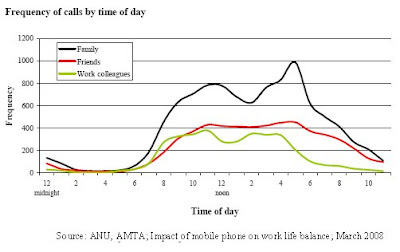
As per my observation the maximum calls are made close to or after lunch time as this is generally the time when children return from school (see figure given above). (Data has been taken from ANU, AMTA; Impact of mobile phone on work life balance; March 2008.) Questions about their day at school, some test/exam or some competition follow. Children are then instructed to wash up and change and have proper lunch. Often the children’s nannies are also given a series of instructions over the phone.
An appealing topic of discussion between mothers and children on the phone is ‘homework’. The mom’s tone will become strict and she’ll enquire about whether the child has completed his homework or not. If he has done it he will receive a one-minute praise and the mother will then ask the poor child to learn some spellings or do some Math. Only then the child will receive the ticket to go out and have fun or watch some TV. It is torture for the child. I can say this because I have experienced it so many times in my childhood, when my mum called up from her office to check on me. She especially called up during exams and if some exam didn’t go well she first reprimanded for being careless and not preparing well and then consoled and motivated to do better for the next paper.
The calls again peak in the evenings (see figure given above). This is generally the time when children go out to play. I have many times heard negotiations between mothers and daughters/sons – children pleading to go out and play and mothers instructing them to first complete their homework. Many a times children beg to play with their best friend an hour or so longer and it is up to their mommies to allow them or not. It is really fascinating to witness such discussions. It reminds me of my carefree childhood days.
To conclude – Corporates should provide mobile phone allowance to working mothers as a welfare measure and aid them to balance their work with life at home … LOL
By Sakshi Prakash
Wednesday, June 17, 2009
The Mckinsey Way
As I had nothing better to do this weekend (apart from watching a couple of movies on my laptop), I read this really insightful book – The McKinsey Way by Ethan M. Rasiel. Mckinsey of course needs no introduction. McKinsey is to management as Cartier is to jewellery! Personally, I think it’s a must read for consultants or anyone working in similar functions. This book has a lesson or two for everybody – from people working at the Director level right down to the analyst/associate level.
Though EmPower is not an out-an-out consulting company, we can learn quite a few things from this power pack and try to apply them.
I’ve picked up a few topics, which I really liked, to elaborate on. The first topic is the ‘Rules to live by’ as discussed in the book. These are the rules which McKinsey consultants find very useful for problem solving.
Rules to Live by:
1. 80/20 Rule – this one is a well-known rule. E.g. 80% of sales come from 20% of the sales force. This one is a universal rule for most businesses. By keeping eyes open to this, businesses can come up with ways to improvise.
2. Don’t boil the ocean – like boiling the ocean to get a handful of salt. The mantra is to work smarter, not harder. When problem solving for a client or your own company, don’t try to analyze everything. Be selective and figure out the priorities.
3. Find the key drivers – there can be 50 different factors affecting the sale of your product, but you should focus on the most important ones – let’s say X, Y, Z and ignore the rest. This saves you from boiling the ocean.
4. The Elevator Test – know your solution so well that you can explain it to the client in 30 seconds. If you can do that then you understand what you are doing well enough to sell your solution. To know why this is known as the ‘elevator test’ and how you can encapsulate months of hard work in 30 seconds ... read the book.
5. Hit Singles – this rule says – you can’t do everything, so don’t try. Do what you are supposed to and get it right. The author gives three reasons for this:
a. It’s impossible to do everything single handed
b. If you do it once, you raise impractical expectations from those around you
c. Once you fail to meet expectations, it’s extremely tough to regain credibility
6. Look at the big picture – “perhaps the most valuable thing I learned during my time at the firm was to think about the big picture – to take a step back, figure out what I’m trying to achieve and then look at whatever I’m doing and ask myself, ‘Does this really matter?”, former McKinsey professional.
These are some of the rules given in the paperback. There are a few other good ones too.
Another very resourceful technique which I found was the way of ‘doing research’ as discussed in this volume. Any problem-solving exercise starts with research. One should, however, avoid reinventing the wheel. Whatever the nature of the problem is, chances are that someone has already done something similar. The key then is to look at such previous studies and if possible learn from those who worked on similar problems.
The volume also gives out a few tried-and-tested research tips to jump start your research process. Apart from this it also touches upon - PDNet; an electronic database the firm maintains; the commercial databases McK subscribes to and the excellent business library the firm maintains. All of these aid in the very vital research process.
Other interesting topics include – team building/managing, selling a study, managing hierarchy, work-life balance, and conducting interviews.
The book emphasizes on the fact–based structured thinking culture at McK. I would definitely like to dig into this further and try to understand what structured thinking actually is and how to go about developing it in me for tackling complex managerial problems (of course, this is for the future).
All in all, a great read for self as well as for business improvement!!
By Sakshi Prakash
Reference:
The McKinsey Way by Ethan M. Rasiel
Monday, June 8, 2009
Raison d’ etre
Life is unpredictable! Sorry to disappoint some of you, but life is in fact quite predictable. The certainty about life is omnipresent though in its subtle form. It’s out there but only for those who dare to look in that direction.
When one looks from the angle of management, life is like an ongoing business activity with each individual comparable to a business unit. Like any business entity each person has his strengths, weaknesses, opportunities, threats, core competencies and functions, not in a vacuum but in a dynamic micro and macro environment.
The reason why I am saying that life is predictable is due to this little term called ‘destiny.’ Everybody’s life is predetermined. That omnipotent supernatural power exists. I’m aware that many of us don’t believe in either. Some are atheists, some agnostics and I respect that. A couple of years ago even I did not believe in God or destiny, but now I do. What was the cause behind this metamorphosis of thought, this radical shift, this sudden transformation of my perception? Actually, when I mull over it, it wasn’t sudden at all. The questions were there in my psyche for a long time. Questions like – Why do we need to worship? Follow a religion? Obey a guru? What is the purpose of our existence? Etc., etc. These I suppose nag everyone’s mind at some point or the other. I couldn’t fathom a satisfactory answer to these questions. For people like us I realized the answers lie in becoming receptive, to look at a different perspective, to dare to change.
Now I’ll attempt to explain my rationale behind my beliefs. Being a student of management I can’t help but look at everything from a managerial viewpoint. Using various scientific quantitative techniques one can forecast the future and predict the business environment. At the same time in order to predict on the long-term techniques such as Delphi, expert opinion is used which has a qualitative basis. Similarly, to enable us to forecast our lives there are n number of science art combos which are quite accurate. These methods are proven, have been published in magazines and showcased on television. Just to name a few of these – Brighusanhita, Suryasanhita, Nadi Astrology etc. You can search for them on the Internet as well but, you’ll have to see it to believe it. It’s unbelievable how accurately these can predict about you and your life. Of course deviations are always there. In business forecasts there is always a little difference between actual values and forecasted values. This applies to life as well!
Some of you might argue that through hard work one can change ones destiny. According to me, this is partially true. Destiny can be modified, but cannot be altered altogether. It can be modified through your ‘karma.’ One has to pay for his past karma no matter what. What one can endeavor to do at the most is alleviate the punishment levels. We can look at it this way; there is a tolerance level till which one can make changes. Beyond that there exists a very rare chance of any alteration.
According to Rig Veda, destiny and hard work are two extremes of the human perception. The reality is that both go hand in hand. One has to maintain a balance between the two extremes. For example, a farmer should mow and plough his fields well i.e. put in his efforts. It’s up to good fortune to bring in rains at the right time. Only then he can reap a good harvest.
Those, to whom all of this is resonating as illogical and opinioned, try to look at it as a different school of thought, a different kind of concept maybe…
By Sakshi Prakash
Friday, May 22, 2009
The Changing Face of Social Media
‘Another hottest Web 2.0 startup remains unprofitable.’ This is the kind of news that we hear often these days. One of the greatest challenges of our times has been monetizing user-generated content. This at a time when socializing digitally has become an integral part of our lives.
Innovate or Make Way for Others
Companies that once revolutionized and dominated new industries – like Yahoo!, a Web 2.0 start-up, has seen its profits dwindle and its dominance decrease over the years as others like Google made it run for its money, putting the company up for grabs for the likes of Redmond-based Microsoft – make way for newer ones. Yahoo!, which had long been the No. 2 search engine, behind Google, has been overtaken by YouTube in the United States. YouTube searches grew 114% year over year from November 2007 to November 2008.
Friendster had a great initial vision, and sparked the social networking revolution by allowing friends to hook up with others. The company had an amazing lead and potential. Then MySpace came along and beat it at its own game. But we should not write Friendster’s obituary, just yet. It is seeing a revival of sorts, only this time in Asia. Friendster is now the leading social network in Asia, with over 55 million registered users.
On the other hand, early birds in Social Networking like SixDegrees.com, LiveJournal, AsianAvenue, BlackPlanet, etc. are nowhere on the horizon. What they lacked were self-sustaining business models.
Critical Mass Does Not Translate into High Monetization
We are expected to have more than one billion Social Media users in three years time. We, today, have social networking sites, with millions of users, that lack self-sustaining revenue streams. Social Media participants indulging in high-value transactions that translate into cash money would be any promoter’s dream.
Facebook and MySpace have over 200 million users each. But what they lack are robust revenue streams since they are primarily dependant on advertising monies. Twitter, the darling of the Web 2.0 fraternity, hasn't made any real money and has been surviving on Venture Funding. Digg is still losing money on its pitiful revenue numbers. The central point here is that monetization is not happening despite high adoption.
Challenges Associated with Advertising in an Environment of User-Created Content
Companies are now realizing that their erstwhile revenue stream i.e. online advertising is failing to make the business grow. Players are now ready to experiment and this could not have come at a better time. As per eMarketer, increase in online advertising spend on social networking sites in the US (the largest social networking market) is expected to slow down to 10.2% in 2009 as compared to 33.8% in 2008. A Universal McCann Study in 2008 found that only 14% of users trust advertising, whereas 78% trust recommendations of other consumers.
The likes of P&G are becoming averse to advertising on social networking sites and are now concentrating on engaging their consumers through the launch of their own social networking Websites, running Digital Media promotions on other social networking sites, etc.
"I have a reaction to [Facebook] as a consumer advocate and an advertiser: What in heaven's name made you think you could monetize the real estate in which somebody is breaking up with their girlfriend?”, Ted McConnell, Procter & Gamble's GM for Interactive Marketing and Innovation.
Alternate Ways of Monetizing Are Here to Stay
eMarketer predicts that Facebook and MySpace are expected to enhance their self-serve advertising systems to allow consumers and businesses to buy and sell real-world goods and services in 2009. MySpace is even trying to monetize video content.
Google’s own YouTube, which relies heavily on user-generated content, remains a costly experiment in the high-traffic, low-revenue advertisement business. Google is now expected to try its hand at monetizing this content. Video search already represents 26% of Google’s total search volume.
LinkedIn turned cash-flow positive in 2006, in its third year of operations. As of January 2007, the average LinkedIn user was 39 years old and made $139,000 a year. Of the total user-base, 89,000 were Chief Executive Officers. About 45% of LinkedIn's revenue comes from the monthly subscriptions corporations need to pay to send a meaningful amount of messages as they try to plug into other people's networks of contacts.
Some East-Asian players are also bucking the trend. QQ (from China) had $523 million in revenues in 2007 and an operating profit of $224 million. Only 13% of this came from advertising. The Chinese online advertising market is not as developed as the American one and this induces the players to look for revenue streams other than advertising. It also shows that even in developing markets like China, users are ready to pay for services. This model can be implemented in other markets.
Emergence of New Business Models
Gone are the days of relying on just online advertising. Online players are tweaking their revenue models and launching application platforms. Facebook’s platform, first launched in 2007, now has tens of thousands of applications. MySpace, which mostly relies on Google’s OpenSocial platform, has 4,500 apps available to users, and 211 million applications have been installed. The iPhone, which launched its App Store in July 2008 has more than 15,000 applications, and they’ve been downloaded more than 300 million times. But none has a direct payments platform to let applications collect micropayments from users.
A look at the big news from recent industry shows, like DEMOfall and TechCrunch 5.0, reveals emerging trends that will drive technology innovation next year. Those trends include cloud computing, open mobile platforms and semantic search.
The mobile platform is also expected to be a reliable revenue generator. A case in point is INQ1 – the world’s first social networking mobile phone and has online services like Facebook, Windows Live Messenger, Skype and Last.fm integrated into the phone's operating system, allowing a user to, for example, access their Facebook contacts from the phone’s address book and see a friend's profile picture when they call.
Some players are trying to capture the crowdsourced pools of knowledge floating across the Internet and use them for commercial customer service. Salesforce.com’s recently launched customer service application ‘Service Cloud’ is trying to do just that.
Way Forward
In these challenging times it remains to be seen as to how ready Web 2.0 Start-ups will experiment with newer technologies. Going by the numbers alone, 2009 does seem to be an interesting year. According to Nielson Online, Twitter is growing phenomenally and their number of unique visitors was up 422% in 12 months (August 2008 data for the US). Facebook is expected to have 300 million active users by the end of this year. The numbers are there but what is required now is monetizing user-generated content.
Apart from the new and upcoming models, I would stick my neck out and propose a subscription-based business model. It does seem to be a model worth exploring. It will reduce the number of participants, but will bring in much-needed revenues for the players.
By Navneet S.Aujla
Tuesday, March 31, 2009

Thursday, February 19, 2009


Wednesday, January 28, 2009
Impact of US Recession on India
A recession is a decline in a country’s gross domestic product (GDP) growth for two or more consecutive quarters of a year. A recession is also preceded by several quarters of slowing down. It normally takes place when consumers lose confidence in the growth of the economy and spend less. This leads to a decreased demand for goods and services, which in turn leads to a decrease in production, lay-offs and a sharp rise in unemployment. Investors spend less as they fear stock values will fall and thus stock markets fall on negative sentiment.
As the cliché goes, whenever the US sneezes, the world catches a cold. This is evident from the way the Indian markets crashed taking a cue from a probable recession in the US and a global economic slowdown. Jobs cuts, lay offs and cost cutting measures are the major worries of the Indian masses as they feel the early effects of a looming recession over their heads.
Outsourcing, one of the biggest strongholds of the Indian economy, is going to be hit badly. The IT sector which generates 75 percent of its revenues from the US is probably going to be the worst hit. India’s exports to the US which have grown substantially in the past years are also expected to fall. It is estimated that the Indian economy is likely to lose between 1 and 2 percentage points in GDP growth in the next fiscal year, and worries for exporters will grow as rupee strengthens further against the dollar. The Sensex saw a major shift towards the negative side when it started slipping points from a record breaking 21000 points ending at less than 9000 points. But experts note that the long-term prospects for India are stable. A massive population fuelled by growing domestic demand for goods and services is expected to embrace the Indian economy from a major impact. A weak dollar could also bring more foreign money to Indian markets thus aiding the growth of the economy.
Striking back
The service industry will be the worst hit among all the sectors. BPOs, KPOs, ITeS and other services provided which contribute more than 52 percent towards the GDP growth in India will see a decline. On the contrary, NASSCOM estimates that India will have a shortage of about 5 million skilled people in IT/ITeS which would counteract examples like TCS firing 500 employees due to cost-cutting measures.
K. Ramachandran, Head, Advisory desk, BNP Paribas Private Banking, says Indian companies will have to adopt a multi-pronged strategy, which includes diversification of the export markets, improving internal efficiencies to maintain cost competitiveness in a tight export market situation and moving the product portfolio up in the value chain to impart resilience.
Conclusion
While on one hand we have some parts of the economy affected, on the other, the slow pace of financial reforms taking place in India, regulations towards foreign investments in different sectors and a number of bureaucratic hurdles have actually turned the tables in India’s favor. The recession presents us with a unique opportunity to analyze our own strong as well as weak points. India’s huge population base and a growing domestic demand is one of the contributing factors towards withstanding the effects of the recession to a great extent. It is time we start thinking out of the box and be more innovative to go about the cost cutting in a systematic manner to balance the effect of the rupee.
By Shiladitya Lahiri
Sunday, January 4, 2009
Toward Type 1
Lately I was reading this book, “Parallel Worlds” by Michio Kaku and came across the bizarre idea of categorizing civilizations according to their ability to harvest energy. The idea was first proposed by Soviet astronomer Nikolai Kardashev back in 1964 and later Carl Sagan modified the scale in 1973. However, Kaku elaborated the idea of Type 1, Type 2 and Type 3 civilizations quite a bit.
A Type 1 civilization is the one which can utilize all of the energy its planet receives from the mother star. At this stage a civilization has total control over its planet. It can literally turn off volcanoes, delay the ice age and control the weather! On the other hand, a Type 2 civilization can harvest all of the energy of its mother star, which is almost 10 billion times greater than the energy output of a Type 1 civilization. At this stage a civilization starts to colonize other planets and develops a multi planetary civilization, confined within the periphery of its solar system. However, on reaching the level Type 3, a civilization goes galactic. It masters the energy from its entire galaxy with an output 10 billion times greater than that of a Type 2 civilization. At this stage it colonizes the entire galaxy, draws energy from billons of stars and resembles the galactic confederation of Star Wars!
Now on this scale, our civilization rates a mere Type 0.7, since we are still dependent mostly on fossil fuels. However, going by the present rate of development we can achieve Type 1 status in another 200 years, Type 2 status in a few thousand years, and Type 3 status in about 100,000 to a million years. So perhaps it is too early to think about Type 2 or Type 3, but we certainly are standing at the very doorstep of our own Type 1 civilization. Kaku described the formation of European Union and invention of Internet as the first step towards a Type 1 economy and communication system. But he was not sure whether we’ll be able to achieve this feat or will destroy our kind long before, leaving a nuclear trail behind. Every now and then he expressed concern over the growing act of terrorism and the rising popularity of the weapons of mass destruction.
Reading Kaku I felt the choice is ours whether to follow the vision of scientists like him or of today’s new-age terrorists. A Type 1 civilization is not only tolerant but also supportive to all its life forms, ethnic groups and cultural diversities that coexist in different parts of the same planet. So probably it’s time for us to join hands and take a united step toward a Type 1 human civilization.
By Arijit Goswami
Friday, December 19, 2008
An Ode to EmPower
Across seven seas, when you were born
Never so bright had the sun ever shone
As a little baby, you were given all care
To grow and give happiness everywhere
And your mothers searched all high and low
For the name that would light the happy glow
Empower, Empower, Empower, Empower!
We walked hand in hand with you
To catch little flowers with the morning dew
And when you ran all along the way
We ran with you, all night, all day.
Together we blazed a trial of light
Of knowledge that has shone so bright
They’ve asked for more, Friends old and new
You’ve stood by each time they’ve called out to you.
Empower, Empower, Empower, Empower!
This day our family is larger still
Brimming with joy our cups are filled
We’ll tell them all to call out to you
For the knowledge you will spread their way
You’ll take your place in a million hearts
And win such friends as will never part
As your name will ring across the world.
Empower, Empower, Empower, Empower!
By Sudhakar D R
Wednesday, December 3, 2008
Is Print Media Dying a Slow Death?
There is a fundamental shift in communication and consequently in media as our daily mode of talking, writing and speaking has become increasingly dependent on computers. The fact that you are reading this on a computer endorses this change. The same is happening for businesses and enterprises as the news they get from the main stream media and newspapers is moving towards the online world.
The first act of a day for an analyst in an organization like ours is checking email, and opening up a browser. On this browser page, whether it be Yahoo, Google, or another, the news is one of the first things that they read. And slowly, we find our own ways to keep abreast of all the local developments through the Web – be it bookmarking our favorite news sites and subscribing to RSS feeds or alerts and customizing our preferences.
There is a silent but steady shift of viewership from traditional media to online media, blogs, RSS feeds, Newspaper and Television Websites. But still there is significant need of traditional media for certain industry verticals.
News headlines across the Web and print media flashed several announcements from leading news agencies and newspapers including USA Today, Associated Press, Gannett, Los Angeles Times, Star-Ledger, The Washington Post, and even The Wall Street Journal, about newsroom job cuts ranging from 10-20 percent of workforce. The job cuts reflect the huge losses incurred by the print business of these agencies which implies that traditional media is facing stiff competition from online/new media and losing some ground.
Contrary to above, there is interesting development in another communication realm where companies are increasingly investing intellectual capital in developing brand relationships and business-to-business marketing efforts – the Web 2.0 phenomenon. Blogosphere is suddenly turning out to be the most solicited place for corporate brand building. However, this will be a gradual transition, as people and companies have different learning curves for the social media.
Having said all that, I still have a strong feeling that people are tactile creatures, and they like to touch the newspaper and turn the pages, flip them over and eat and sleep on it. The sense of accomplishment that you feel once you have read the entire newspaper is unfathomable. For me, reading a newspaper is a different experience on its own and I have my own reasons for NOT staying away from it. My newspaper has never crashed. I can carry my newspaper or my favorite clipping anywhere while traveling, I do not need a WiFi connectivity or laptop. I don’t have to go through registration/signing in/customizing my newspaper. My newspaper is not made up of toxic un-recyclable material. And my newspaper provides correction updates with explanations, and it is not sneakily applied to the original story after I have read it. These characteristics of a newspaper would certainly reinforce my loyalty towards print media forever.
By Debanjan
Sunday, November 30, 2008
An Ode to the Earth – My Home
I forget what it is to feel the first rays of the sun,
I live under the glare of artificial lights.
I forget what it’s like to feel the rain on my face,
I am too busy trying to avoid the next pothole.
I forget what it is to feel the earth beneath my feet,
I see only paved concrete wherever I go.
I forget how blue the sky can sometimes be,
I can’t see past the skyscrapers any more.
My flat is in the heart of the city,
My heart is still searching for my home.
I ache to be free from within, I ache to belong.
I want to feel in my soul, the bliss of being in my own home.
I lose you everyday in a thousand different ways.
And I can’t take it any more.
I will fight to keep you healthy, not for a coming generation or for a cause.
But because, you are me and I can’t let you go like this.
By A Geeta
Wednesday, November 26, 2008
Think about Yourself
What if you could think whatever you want to and whenever you want to? What if you felt joy, love and peace all the time, or even most of the time? Can you think of some old feeling that you would rather not be carrying around, or a behavior that you don’t like anymore and you would like to let it go? Now is the time. Your mind thinks as it was trained to. Over the years you have downloaded from your senses various thoughts, feelings, opinions and beliefs that rule over your life. Some of them may be quite helpful to you while others may be keeping you from realizing your full potential, or just being happy and prosperous.
You can consciously decide how you want your brain to work, and if there is something in your mind you no longer want to think about, you can now change it because it’s your mind and, of course, your thoughts. Your own mind may not believe this, and may even fear the idea, but if you would like to change what goes on in your mind and body the first step is in realizing that you can…absolutely. The other way you can do this is by accepting the things as they are rather than wishing that those would have been the way you wanted them to be. The second step in this process is in realizing what your thoughts and feelings are and how they are affecting your life. Which thoughts benefit you and which ones don’t? The next step is to consciously decide how you want to think and how you don’t. When I say this I also mean that we should give some priorities to negative thoughts in our life. Because every time one cannot have a bed of roses in one’s life, right???
The clearer your mind is as to what you want it to think, the easier it is for your mind to think about it. You would also make up your mind to face the negative things as well.
Once you have gained clarity in as to what you want your mind to think, it is simply a matter of programming your mind to think that way. Just like the way you learn a language, as you repeat ideas and feelings they become ingrained into your brain and are adopted into your own personality and behavior. Thought-forms can be created in your mind and firmly established so that your mind becomes the perfect servant to your own consciousness. Where there is a negative you create a positive, where there is fear you create courage and strength, where there is discord you create harmony. And believe me this really works. Though it sounds like forcing yourself to do this.
Look how enslaved most people are to their mental and emotional conditioning. There is absolutely no reason to stay in a contracted mental or emotional state; you can start shifting and reprogramming your mind once you decide to. This choice is the power that makes it happen. Your spirit is guiding you to make these choices, just as it guided you to read these words.
Emotionally, physically and mentally let us create those thoughts and feelings that bring greater prosperity, happiness and peace into our life. Why settle for anything else?
By Andrina Pais
Sunday, November 23, 2008
Music to my ears
Some days back we had a small discussion on whether music distracts an employee while working.
Well, just thought of sharing a few thoughts on that.
I am one of those who are mild users (and I mean it in the true sense of the word) of music at work. The kind of music I listen to matters a lot too.
Having a research-oriented profile it’s important for me to concentrate and read between the lines. In case the music has nice lyrics and it’s one of my favorites, it will be difficult to focus on the task at hand. However, if it’s instrumental or heavy metal (No offence meant to Iron Maiden/Fans) there is no distraction. On the contrary it proves beneficial in keeping away all outside noise and allows me to focus on the project.
A nice gazal or a country number from John Denver (my personal fav…) will definitely go a long way in aiding your work. It helps you relax and soothes your already agitated nerves (Well ROD does that to you at times—wish I could be invisible at this point ;-) )
We generally have long days at work, which translates into a lot of yawns and sluggishness which reflects in our work. Well, besides a nice cup of coffee, peppy Punjabi beats or a Mambo No. 5 can lift your moods and WAKE YOU UP (Does this seem like an online diary already ;-) ?).
BY the way it’s scientifically proven that listening to music can reduce chronic pain and depression by up to a quarter (Source: Science Daily).
Well, enough said already, I guess it’s time to buy that attractive ear phone and shell some money for the iPod (even look alikes should do).
So at the cost of borrowing from a perky number … Get Jiggy with it people.
By Varun Kumar


